
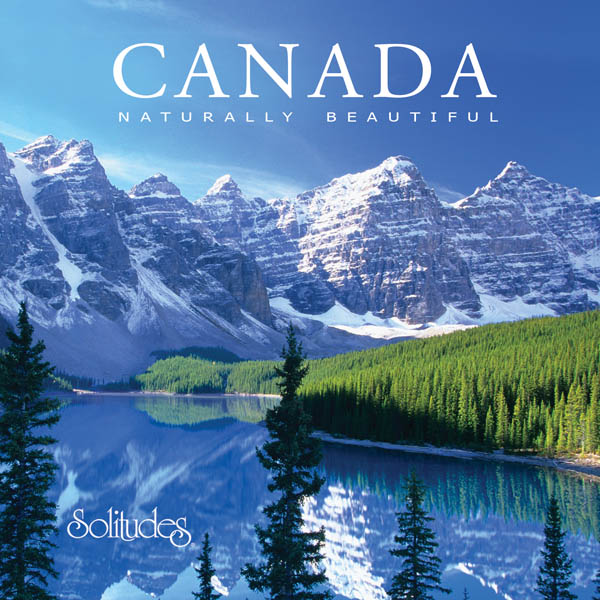
Canada: Naturally Beautiful
Artist: Dan Gibson's Solitudes
Label: Solitudes
UPC: 96741250927
Catalog ID: 48022
Founded in 1867, Canada is considered young as a country. But its vast geographic diversity and astounding natural beauty are timeless. From lush old-growth forests and sprawling mountain peaks to sweeping tallgrass prairies and meandering coastlines, each locale is alive with colour and rich with history.
In respectful tribute, composer John Herberman presents Canada: Naturally Beautiful, a stirring orchestral score complemented by the celebrated nature sound recordings of Solitudes® founder Dan Gibson. Worthy of a big-screen epic, the album magnificently portrays a proud nation and resonates with quiet power. At once poignant and jubilant, intimate and restorative, Canada explores the farthest frontiers of a glorious land and creates a deeply moving listening experience that lingers long after the last golden note fades.
Glorious and Free
Gros Morne National Park
Newfoundland & Labrador
Traveling from the lowland bogs alongside the Gulf of St. Lawrence to the arctic barrens of the Long Range Mountains, visitors to Gros Morne National Park might feel as if they’ve stepped back in time. Taking its name from Newfoundland’s second-highest mountain, part of the park is an extension of the Appalachian Mountains, believed to be 20 times older than the Rockies.
The region is a spectacle of contrasts—boundless coastline, colorful fishing villages, freshwater fjords, thriving wildlife, primeval tablelands, alpine tundra—as much a sightseer’s delight as it is a geologist’s dream. Shaped by several hundred million years of dramatic change, Gros Morne offers a rare example of plate tectonics, through which colliding landmasses forced oceanic crust, mantle and sedimentary rock to be exposed above the earth’s surface.
Beyond its rugged beauty and depth of ecosystems, it’s Gros Morne’s unparalleled geological richness—and invaluable role in teaching us so much about earth’s natural history—that earned the park its designation in 1987 as a protected UNESCO World Heritage Site.
Song of the Soul
The Maritimes
New Brunswick, Prince Edward Island & Nova Scotia
From New Brunswick to Nova Scotia and PEI in between, the Canadian Maritime provinces share a colourful past, built of nautical lore and the cultural influences of the French and Celts. Each has left its mark on this idyllic region, which brims with natural beauty and soulful legacy—a legacy indwelled in the craggy Maritime shores and in the fiddler’s emotive songs.
From the north-easternmost tip of the Appalachian Mountains to the untamed coastline, the landscape of the Maritimes is as legendary as it as breathtaking. Atop the coastal barrens of Nova Scotia, one can almost see the ancient schooners at sea, heeding the late-night messages of a self-assured lighthouse. Countless windy peninsulas make an ideal perch for bird and whale watching, as scores of wildlife pass by their shores on a journey to milder climes.
Hallmark to the Maritimes landscape is the network of quaint, historic fishing villages dotted along the coast; each whitewashed building and wake-battered dock a testament to the reliance Maritimers have on the sea, as well as the wear the sea ultimately has on the people. There is a unique balance struck in the Maritimes—one of give and take; of land and sea; of past and present. It is one that speaks deeply of the pride her people have in their land and their landscape;s a pride, soaring like the fiddler’s song, in the wind and across rocky coasts, where it rests, eventually, atop the crest of an Atlantic wave.
Reverie
La Gaspésie
Québec
Both a rugged peninsula and picturesque Maritime community, the Gaspésie lies on the eastern tip of Québec, distinguished by its depth of history, flourishing wildlife and striking seaside panoramas. Here, the sky seems to stretch on forever and the sprawling Appalachian Mountains dip dramatically into the Gulf of St. Lawrence. Perhaps this is why the indigenous Micmac Indians called it Gespeg—Land’s End.
Inhabited by the Micmac for thousands of years, the Gaspésie became a mecca for European settlers. In 1543, French explorer Jacques Cartier established trade relations with the Natives and claimed the territory. Today, the Gaspésie is divided into five distinct areas, each with its own natural charm and character. The presence of early settlers had a lasting cultural influence here, and each municipality carries a unique flavour reminiscent of its European roots.
An idyllic land where past meets present, the Gaspésie offers a contrasting backdrop of meandering shorelines, peaceful fishing havens, blossoming valleys, mountainous wilderness, century-old lighthouses and covered wooden bridges. So great is the region’s timeless beauty that it encompasses several natural reserves—including Parc national de Miguasha, a UNESCO World Heritage Site with fossils dating back 380 million years; and Parc national de l’Île-Bonaventure-et-du-Rocher-Percé, where visitors can step into the Gulf of St. Lawrence at low tide and visit an ancient, distinctively shaped 5-million-ton monolith.
Wonder in the Mist
Niagara Falls
Ontario
Gazing into the swirling currents of Niagara Falls, it’s hard not to find yourself captivated by such hypnotic beauty. With a humbling majesty rivaled only by its own sheer might, the Falls creates one of the loudest continuous sounds in the world and can be heard for miles.
Niagara is separated into two major parts: the Horseshoe Falls in Ontario, Canada, and the American Falls in New York State. A byproduct of glaciers receding 12 thousand years ago, the Falls are likely to have received their name from the Onguiaahra (“Thunder of Waters”), a tribe of Native Indians inhabiting the region in the late 1600s.
Beyond Niagara’s role as a historical, geographic and cultural icon, this enduring force has also been harnessed to produce hydroelectric power for Southern Ontario and Western New York. But there’s a softer, gentler side to the Falls, as scenic public parks, winding streams and a celebrated wine country nearby offer pleasant diversions from the mist-shrouded natural wonder. At night, the Falls are illuminated in a breathtaking display of colour, and at the height of winter, glittering ices bridges forming beneath them add an enchanting touch to an already impressive spectacle.
Waves of Gold
The Prairies
Manitoba & Saskatchewan
Leading an expedition in 1858 to explore the prairies of Manitoba, geologist Henry Youle Hind was so captivated by them that he was inspired to write:
“The vast ocean of level prairie … must be seen at sunrise, when the boundless plain suddenly flashes with rose-coloured light, as the first rays of the sun sparkle in the dew on the long rich grass, gently stirred by the unfailing morning breeze.”
This glowing portrait revealed Canada’s heartland in pristine times—a bold new world beneath wide-open skies, alive with a changing natural beauty that can become golden at midday and tinged with silver at midnight. And while they may seem similar at first glance, the prairies of Manitoba, Saskatchewan and Alberta form a mosaic of three unique grasslands. Tallgrass, high and luxuriant, was described by early explorers as rising above the bellies of their horses. Mixed prairie, which makes up over half of Canada’s native grassland, is dominated by medium-height grasses, with short grasses and sedges forming a second, lower layer. Fescue, lush and colourful, blossoms brilliantly in season.
But alarmingly, overdevelopment and overgrazing of the land have taken a critical toll and the “vast ocean” portrayed by Hind over 150 years ago is now an endangered ecosystem. In light of this sobering reality, careful stewardship of the remaining prairies is crucial to preserve them for future generations.
Tracing the Heavens
Northern Lights
Yukon, Northwest Territories & Nunavut
In few other places can the Northern Lights be better seen than the evening skies of the Yukon, Northwest Territories and Nunavut. Captured in verse by such renowned writers as Robert W. Service, the mystical lights have been steeped in world legend for thousands of years.
In ancient Asia and medieval Europe, they appeared as omens, battles or heavenly warriors. The Athabascan Indians of Alaska believed they were messages from the “Sky Dwellers,” thought to be incarnations of the dead. To the Inuit, they were the souls of deer, seals, salmon and other creatures that they hunted.
Also known as the Aurora Borealis, this mesmerizing spectacle carries the namesake of Aurora, Roman goddess of the dawn, and Boreas, Greek god of the north wind. A changing celestial display that traces the heavens like a rippling serpent at one moment and dances overhead like a fluttering veil the next, the Northern Lights illuminate the bleak expanse of arctic tundra, glacier-fed lakes, stunted forests and ice-capped mountains with an ethereal glow of green, violet and blue. Such is the brilliance and unsurpassed majesty of the Northern Lights that it’s considered one of seven Natural Wonders of the World.
Soaring Splendour
Banff National Park
Alberta
When workers for the Canadian Pacific Railway discovered geothermal springs in an Alberta cave of the Rocky Mountains in 1883, they couldn’t have imagined it would become the start of something momentous. The find, and the excitement it created, led the Canadian government to establish a 26 square kilometre public park around the site called Banff Hot Springs Reserve. It was this pioneering act that laid the foundation for Canada’s National Parks system.
Later expanded to 674 square kilometers and dubbed Rocky Mountains Park, it wasn’t until 1930 that the region was finally christened Banff National Park—the first of its kind in Canada. Today, Banff is an extraordinary 6,641 square kilometre expanse of placid cerulean lakes, soaring alpine peaks, rough-hewn glacier fields, dense coniferous forests and blossoming meadows. Home to grizzlies, wolves, caribou, elk, deer and moose, it also boasts over 1,600 kilometres of hiking trails—more than any other mountain park.
As Banff is one the most famous and frequented national parks in the world, the preservation of its ecosystems is essential. To address this initiative, an amended version of the Canada National Parks Act was passed in 2000, making maintenance or restoration of ecological integrity the overriding priority in park management. On its 100th anniversary, Banff became one of four Canadian Rocky Mountain Parks (including Jasper, Kootenay and Yoho) to be collectively declared a region of “outstanding universal value” by UNESCO, and was designated a World Heritage Site.
Ancient Spirit
Clayoquot Sound
British Columbia
On the western coast of Vancouver Island sits a unique collection of islands and fjords, beaches and inlets, forests and mountains—a land both varied in scope and rooted in history. The traditional home of the Nuu-chah-nulth people, this beautiful temperate rain forest – the rarest of its kind, inhabiting less than 0.2% of the world’s surface—serves as habitat to an immeasurable and invaluable assortment of living species, from the smallest clams of the mud flats to the great humpback whales and soaring Sitka spruces.
A majestic landscape brimming with untold secrets, Clayoquot Sound was designated a UNESCO World Biosphere Reserve in 2000. Unfortunately, it remains an area in desperate need of further global protection. Prized for its ecological importance as well as its industrial bounty, Clayoquot Sound has been weathering the pressures upon her with the resourcefulness of an ancient sage.
There are many efforts underway to help keep this disappearing landscape pristine, but perhaps the best way to understand its immense ecological importance is to simply sit among the grand trunks of the primordial forest, to look upwards into a canopy that grazes the heavens, and to breathe in the forests lush, unsullied air. It is imperative to the survival of this precious land that we listen now to the timeless message of the Sound’s first inhabitants, and realize, as the Nuu-chah-nulth people counsel, Hishuk-ish ts’awalk (“Everything is one”).


Track Listing
Glorious and Free
8:01
Song of the Soul
7:02
Reverie
8:07
Wonder in the Mist
7:20
Waves of Gold
7:24
Tracing the Heavens
6:58
Soaring Splendour
8:26
Ancient Spirit
8:14
Interested in Licensing a Track?
Use the form below to provide the essentials of your request and we will be in touch as soon as possible.